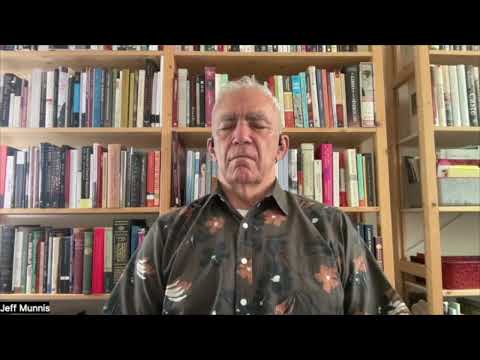
Overcoming Obstacles to Growth and Transformation
A message channeled during a group session on May 5, 2024, by Rev. Jeff Munnis about how to overcome the part of ourselves that gets in the way of our growth and transformation.
Transcript
I want to speak to you today about the part of ourselves that gets in the way of our growth and transformation because the language can sometimes be difficult. When we speak about growing and transforming, we’re speaking about the dissolution of that part of ourselves that gets in the way of understanding the deepest, most essential part of our identity. And when this part of us gets in the way, what does it feel like? What kinds of emotions rise to the surface, and how do we clear a path through those feelings or emotions to get to that deeper part of ourselves? First, the things that enter into our consciousness, the patterns or the scripts, the conditioning that comes from our life in this material realm are usually the first things that arise. And we can even confuse those voices with something like our conscience. But our deeper self doesn’t work with us the way the conscience works with us. Our conscience is too easily used as a tool against us by our ego. So we have to understand that the first prompting, unless it comes from a deep, deep rooted part of ourselves is usually this co-opted part that takes a moral attitude or a superior attitude or a should kind of attitude—something that tells us we’re either not worthy or it over inflates us to the point where we feel like we’re right or we become arrogant. There’s almost no in-between ground when these parts of ourselves arise. They either arise into a state of desire that feels something like bliss that we then chase after those desires, or we descend into a negative or a self-loathing state that diminishes us and makes us feel hurt or pain or a different kind of suffering. So those are the first things that arise. And part of being able to tell that these are not coming from a deeper intuitive place within us is they usually become tightly connected to an emotion, a single emotion. So, they might elicit fear or anxiety first, and then having fully distracted us, the ego then plays with a mixture of emotions to keep us off balance and under the control of that conditioned part of ourselves. So, it is the dissolution of this part of ourselves that actually tracks with what we would call our growth in awareness and our transformation. So that part of ourselves that becomes aware, that experiences a different kind of empathy where we kind of lose our sense of ourselves, where there is not something that we feel we must acquire or pull into our orbit, that’s a different kind of sign that is more closely connected to that most essential part of ourselves. When we say we are transformed, that process of transformation means that that persona or ego part of our mind and our psychology, our psyche, is actually shrinking. And so, with the shrinking of the ego, the shrinking of certain kinds of desire, those coincide with the expansion of our consciousness.
Now, what is another way that we can see this process working inside of ourselves? Another way is to sense or feel this process through a non-identification with the world. And by that, I mean that no place feels like home. There’s the sense that there is always a different place that will be a better place, or a place where you’ll feel stronger. But the key element of this sense of not being at home comes with a huge dose of humility. It comes with an understanding that no matter how much you try to control the circumstances of life, you realize more and more that we’re not in control of all the aspects of our life.
So, we want to back up a little bit and talk about that as part of our understanding of our identity. That feeling of not being at home and seeking of a home is left over from our individual separation from the whole. Now, this separation is not a fact, it’s a sense of where our consciousness is directed. So, once we direct our consciousness away from our source to the created world, of which we participate in the creation, that loss of an awareness of the whole contributes to that sense of not being at home. So, we could say that in our transformation as a human being, if you have that sense of not being at home, it’s a way of knowing that you’re farther along your path of awareness. You know that you’re farther along in understanding the deepest, most essential part of our identity.
Ant that brings us to another element of this underlying oneness that we all share. The sense that there is movement, the sense that we achieve something or that we move toward something is also a part of the illusion of this world because God, this most-essential part of us is already present. And when we see the world, if we understand this aspect of God’s presence and the unity that exists, we can actually begin to see the world as an expression of God. In hearing this, it can feel ominous if you think only of the overwhelm and awesomeness of the way things feel when you feel overpowered or when you feel a negative energy of another person, an event or something that you don’t understand. This feeling, as you get closer to that essence of God, is like the last grasp to control by the ego. There’s fear of death. There’s fear of the very dissolution of self that is necessary to experience that presence and that oneness. Since God is so fully present, and there is this underlying unity, we move toward God in a sense when God reaches out to us. Now, that reaching out to us is constantly in process. We’re actually an extension of that life that is in God. So, you have this mixture of feelings that says well God is here but them I’m reaching toward God or God is reaching toward me. Knowing that that love and that life that is reaching out through us and in us in which we live, when we fully realize that element of our identity, when we know that we can never be separated from that love, when we know if not just in our intellect but when we feel it in our bones, so to speak, or deep in our body, in the core, not just of our being, but in the core, like feeling it in our stomach, that’s grace. In that state of grace, the most powerful sense of one’s own self-worth begins with forgiveness. It begins with each of us allowing ourselves to let go of all those things that we hold ourselves responsible for. All those things that we feel like we should have done or been aware of, we begin to understand that from that deeper place, that the love that is God looks through those things, beyond those things into that most essential part of us that everything is cleared. Everything is purified. Everything is washed away. Everything is dissolved.
So, listen carefully to this part of what I am saying again. And follow what I am saying knowing that this is the place that is both our origin and our destiny. Know that there is a gift in this awareness, a grace in this awareness, an understanding of our value in this awareness because the very things that we value as an expression of God are also part of our most-essential selves in union with God. That extension of God that experiences the world through us, that part of God that feels what we feel, that shares our experience loves us all the way through the process. So, we do something like meditation, chanting, or worship, or any number of spiritual practices simply to focus on one thing so that most of the rest of what surrounds us dissolves, and eventually our own ideas about that one thing, whatever it is we happen to use to learn how our mind functions, eventually that one thing also dissolves.
In this world, in this life, we’re not meant to sit in that space all the time. We’re here to learn all of the aspects of material existence, all of the experiences of a material realm. But we’re not supposed to be overcome by those things, and those things are not meant to rule us, even though we may enjoy them and let them unfold around us. So, the enjoyment and the beauty of this world is there to remind us of the beauty of God and of creation. It is the deeper understanding of our identity that we sometimes connect to, both intentionally and unintentionally that brings us the awareness of the unity and the oneness of that experience with each other.
So, these elements of our being, we sit and learn so often about karma, about illumination, about practice, about awareness, about what it means to grow, and all through that process grace is there to help us on our journey. It’s there to help us rest and renew ourselves. It’s there to remind us that in that learning about our true selves, there is a transformation where we can see and hear and experience all of our senses in their spiritual essence. And in those spiritual essences, those are the moments of bliss that come with love and devotion or knowledge and wisdom, there are so many paths to this Divine part of all of us and all of creation, and that too is part of grace.
(S.G. - This connection between grace and forgiveness, it feels like that’s been consistent the last couple of times when we’ve gathered. I’m just wondering if anyone else is wanting to point in there? What more there is to delve into for each of us?) Each of us identifies with different parts of ourselves, but also, we identify with different experiences. And if we’re not cautious in how we see ourselves, we identify more with our experiences than we identify with that most essential part of ourselves. So again, linking that to the grace and the forgiveness in some ways is to break the link to the identification of the experience with ourselves. We can still have the experience, but it doesn’t become our identity, which is much deeper-rooted in this essential connection between ourselves and God.
(M.M. - I’m trying to process when we’re going through this transformation that no place feels like home, could you expand in terms of no place feels like home? Is that we’re not feeling settled anywhere? Can you expand on that?) It might take different forms depending on how we see home until we get to the understanding that our true home is in God. That doesn’t mean, just as I said earlier about our sensory experience, it’s not meant to say that we can‘t have a feeling of home, it arises for us primarily in ways that are not helpful to understanding our true home. So, as we feel unsettled in any way, it doesn’t matter if it’s a feeling about home or it’s a fear or an anxiety about security or danger that’s around us, all of those, they can be helpful if we understand them in the context of this world and separate those experiences from our identity, especially from that most essential part of our identity, knowing that we are that extension of God in the world, and we truly have nothing to fear. So, those experiences of home, the pleasure of those are there for us to experience, but they can’t become the object of our love and our devotion when they’re disconnected from the source of all creation and disconnected in such a way that we identify with that, much like the golden calf in the Bible—the worship of an idol, or the objectification of something outside of ourselves in such a way that we use it in a selfish or a destructive way. But I guess the short answer to your question is yes, it can be an unsettled feeling, just being unsettled wherever you are. Your true home, the deepest location of your acceptance and rest is in God.
When we say that there are many paths to this home, part of what we are saying is that there are many experiences, many ways of seeing things that when we disassociate our identity from those experiences, all of them lead to this place of acceptance and grace. So there is, you might say it this way, a unifying place of all things, a ground that is the ground of all being in all things, and we each are able to drop into that, and we say “drop into,” not because we’re not already in it, but primarily because we are letting go of our attachment to all those things that are not truly part of who we are, and when we do that, it feels like rest.